





EU Multiannual Financial Framework (MFF) 2028 - 2034
What happens in MFF negotiations?
The Multiannual Financial Framework (MFF) is generally negotiated on two levels: the overall MFF structure and programme regulations. For the music sector, we are especially looking at the following aspects and programmes:
MFF budget and overall structure and set-up:
- General structure and overall budget
- Own resources EU, digital fines
- Indicators and performance framework
Programme regulations (more on the programmes below):
- AgoraEU
- Competitiveness Fund
- Horizon Europe
- National and Regional Partnership Plans (with the European Social Fund - ESF and the European Regional Development Fund - ERDF)
- Global Europe
Watch this page for more updates to come on the MFF negotiations
AgoraEU
Latest updates
(as of July 2026)
An overview of the latest developments in the AgoraEU negotiations
- The amendments (document one and document two) on the draft report on AgoraEU were published which make further suggestions by several MEPs on the newly proposed Annex to AgoraEU. These will be voted upon together with the draft report on 19 October in the CULT and LIBE committee.
- The draft report on AgoraEU by rapporteurs Emma Rafowicz (S&D, FR) and Alice Kuhnke (Greens/EFA, SE) in the European Parliament published in May 2026 proposes a new structure of strands for AgoraEU compared to the Commission proposal incl. a dedicated music strand. The vote on the draft report is expected for 19 October followed by a vote in the plenary at the end of October.
- On 12 May 2026, the EU culture ministers agreed on a partial mandate on the AgoraEU programme. This agreement covers the objectives, priorities and overall structure of AgoraEU but does not cover the budget or other horizontal aspects.
- On 28 April 2026, the European Parliament adopted its interim report on the Multiannual Financial Framework (MFF) 2028 – 2034, calling for a 10% increase in the overall EU budget. For AgoraEU, the Parliament proposes €10.72 billion, around 25% more than the European Commission’s proposal of €8.58 billion, though still below the CULT Committee’s call for a 12 billion Euro budget of AgoraEU.
- The Commission published their proposal for the AgoraEU programme in July 2025.
Proposal by the European Commission
In July 2025, the European Commission presented its proposal for the future Multiannual Financial Framework 2028 – 2034. AgoraEU is the new name for the programme bringing together the Culture strand and MEDIA strand of the (current) Creative Europe programme and the Citizens, Equality, Rights and Values (CERV) programme. The budget proposed for AgoraEU is 8.6 billion Euro which is distributed across the three strands as follows:
- Creative Europe Culture strand: 1.796 billion Euro
- MEDIA+ strand: 3.194 billion Euro
- Democracy, Citizens, Equality, Rights and Values strand: 3.593 billion Euro
This represents an increase compared to the current programme structure e.g. from 805.9 million Euro in the current Culture strand to the proposed 1.796 billion Euro.
The general objective of the AgoraEU is to “promote cultural and linguistic diversity and heritage, to increase the competitiveness of the cultural and creative sectors, in particular the media and audiovisual industries, to safeguard artistic and media freedom, and to protect and promote equality, active citizenship, rights and values as enshrined in the Treaties and in the Charter, thereby enhancing democratic participation and societal resilience.”
In addition to this general objective, the proposal also defines specific objectives for each programme strand. For the Culture strand the objective is to “contribute to cross-border cultural creation, cooperation, participation and accessibility, and cross-border circulation of a diversity of cultural works, while strengthening the social, economic and international dimensions of the cultural and creative sectors”.
AgoraEU negotiations in the European Parliament
Responsible committees: Culture and Education (CULT) and Civil Liberties, Justice and Home Affairs (LIBE)
- Rapporteurs: Emma Rafowicz (S&D, FR) for CULT and Alice Kuhnke (Greens/EFA, SE)
- Draft report discussion in committee expected for June 2026
- Vote in EP plenary expected for October/November 2026
On 28 April 2026, the European Parliament adopted its interim report on the Multiannual Financial Framework (MFF) 2028 – 2034, calling for a 10% increase in the overall EU budget. For AgoraEU, the Parliament proposes €10.72 billion, around 25% more than the European Commission’s proposal of €8.58 billion, though still below the CULT Committee’s call for a 12 billion Euro budget of AgoraEU.
The draft report on AgoraEU by rapporteurs Emma Rafowicz (S&D, FR) and Alice Kuhnke (Greens/EFA, SE) proposes a new structure of strands for AgoraEU compared to the Commission proposal incl. a dedicated music strand. The draft report will be debated in the CULT and LIBE committee on 3 June with a vote expected after the summer.
The amendments on the draft report on AgoraEU were published which make further suggestions by several MEPs on the newly proposed Annex to AgoraEU. While some amendments keep to the structure proposed by rapporteurs Emma Rafowicz and Alice Kuhnke, some amendments don't include a separate music strand but rather incorporate sector-specific funding for music as part of the sectoral actions in the Culture strand along with sectoral support for other cultural sectors.
Once this report is adopted by the Plenary of the EP, this will be the negotiating position of the European Parliament.
AgoraEU negotiations in the Council
The Education, Youth, Culture and Sport (EYCS) Council is responsible for AgoraEU. Preparatory work took place in the Cultural Affairs Committee (CAC) during the Danish and Cypriot Council Presidencies.
On 12 May 2026, the EU culture ministers agreed on a partial mandate on the AgoraEU programme. This agreement covers the objectives, priorities and overall structure of AgoraEU but does not cover the budget or other horizontal aspects. Based on the European Commission proposal for AgoraEU from July 2025, the EU member states make several suggestions for changes also for the Culture strand of AgoraEU:
-
Updating the definition of cultural and creative sectors
-
Calling for sectoral support schemes in the cultural strand for the music sector, book publishing and libraries in addition to the horizontal funding schemes
-
More explicit creation of AgoraEU Desks offering guidance and assistance for applicants
Other changes proposed concern the governance of the programme with the creation of an AgoraEU Committee which would strengthen the role of member states in the implementation of the programme e.g. when developing the Annual Work Programmes.
EMC position
Following the publication of the draft report in the European Parliament, the EMC joined a statement along with 26 music networks welcoming the addition of a music strand in AgoraEU.
The EMC has contacted Members of the European Parliament in the CULT committee with concrete suggestions for amendments on AgoraEU following exchanges with EMC members during the Round Table on 3 February 2026 and online lounges. These cover sector specific support for music i.e. the continuation of Music Moves Europe, reformulation and additional suggestions on the specific objectives of the Culture strand i.e. on the network support as well as a proposal how to include a definition of the cultural and creative sector in AgoraEU. Generally, the EMC supports an increased budget for AgoraEU, an earmarking for the culture strand of at least 33%, revenues from digital fines to top-up the AgoraEU budget as well as further specifications on the funding lines and the future of the Creative Europe Desks.
European Competitiveness Fund
The European Competitiveness Fund (ECF) combins several instruments of the EU on it's strategic priorities. It merges programmes like Digital Europe, EU4Health, InvestEU and LIFE but also the European Defence Fund and the European Defence Industry Programme. The research programme Horizon Europe is also part of the ECF but has it's separate financial envelope.
For the music sector, the digital leadership component of the ECF is relevant which is set to support start-ups, scale-ups and SMEs in particular on digital and AI technologies, technological sovereignity, advancing digital applications and services etc. It also specifically mentions the 'support to cultural and creative industries, complementing the AgoraEU programme'.
ECF negotiations in the European Parliament
Responsible committees: Industry, Research and Energy Committee (ITRE)
Rapporteur: Christian Ehler (EPP, DE)
Several other committees in the European Parliament will provide an opinion regarding their policy on the European Competitiveness Fund. The Culture and Education Committee (CULT) is not included in that list. The CULT committee has made reference to the Competitiveness Fund and its relevance for the cultural and creative sectors in other contexts. This includes the (draft) opinion on Horizon Europe which is closely interlinked with the Competitiveness Fund. The draft opinion of the CULT committeee on Horizon Europe by rapporteur Laurence Farreng (Renew, FR) was published on 20 January 2026 which for example states that "Cultural and creative industries have a clear strategic potential for the competitiveness of the Union, especially within the context of digital innovation."
The draft opinion on the Interim Report on the MFF 2028 - 2034 makes very concrete proposals regarding the European Competitiveness Fund. The draft opinion on the MFF prepared by rapporteur Helder Sousa Silva (EPP, PT) calls for "dedicated earmarking and budget line" for the cultural and creative sectors in the European Competitiveness Fund.
Opinion Culture and Education Committee (CULT)
Rapporteur: Laurence Farreng (Renew, FR)
Draft opinion published on 20 January 2026: includes proposal for more specific references of CCI and culture-specific calls
ECF negotiations in the Council
The Permanent Representatives Committee decided to set up a European Competitiveness Fund (ECF) subgroup within the Ad Hoc Working Party on the MFF.
Progress report in the Council on the ECF (November 2025):
The latest (published) Revised Presidency text makes additions and deletions in comparison to the Commission proposal. This includes deleting the reference to the cultural and creative industries in the 'Digital Leadership' section.
Horizon Europe
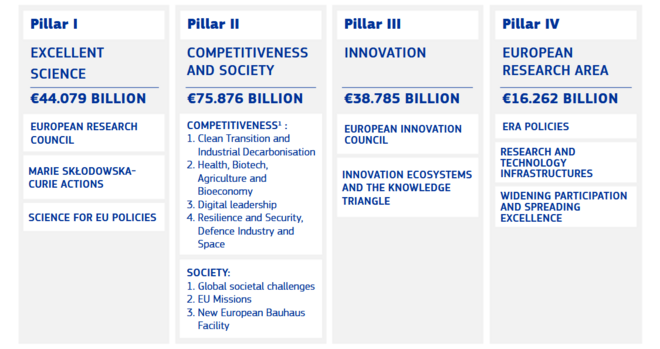
Horizon Europe 2028 - 2034 is the proposal for the framework programme for research and innovation. The general objectives of the programme are strengthening the EU's competitiveness and its scientific and technological basis as well as addressing global challenges on excellence in research and innovation.
It consists of four pillar: 'excellent science', 'competitiveness and society', 'innovation' and 'European Research Area'.
The most relevant pillar is 'competitiveness and society' which also includes the New European Bauhaus Facility. Compared to Horizon Europe 2021 - 2027, there is no longer a dedicated cluster or component for culture and creativity. There is also no earmarked funding for research and innovation in these fields of culture and creativity. In this new proposal, the Competitiveness and Society pillar shall address ‘societal challenges, including culture and creativity’. Additionally, the programme proposal includes a horizontal principle ensuring a multidisciplinary approach to ‘provide for the integration of social sciences and humanities (SSH) across all components under the Programme, including specific calls for proposals on SSH related topics'. This leaves room for future calls for proposals that address specific topics and challenges of the music and cultural sector, it is however a significant decrease in visibility.
The Briefing Document from the European Parliament provides a good overview of the proposal for Horizon Europe 2028 - 2034.
Horizon Europe negotiations in the European Parliament
Responsible committees: Industry, Research and Energy Committee (ITRE)
Rapporteur: Christian Ehler (EPP, DE)
The draft report by the ITRE committee was published in early March 2026. It currently includes one amendment suggestion to more explicitly include the cultural and creative sectors in Horizon Europe.
Opinion Culture and Education Committee (CULT)
Rapporteur: Laurence Farreng (Renew, FR)
The draft opinion of the CULT committeee on Horizon Europe by rapporteur Laurence Farreng (Renew, FR) was published on 20 January 2026 which for example states that "Cultural and creative industries have a clear strategic potential for the competitiveness of the Union, especially within the context of digital innovation."
National and Regional Partnership Plans
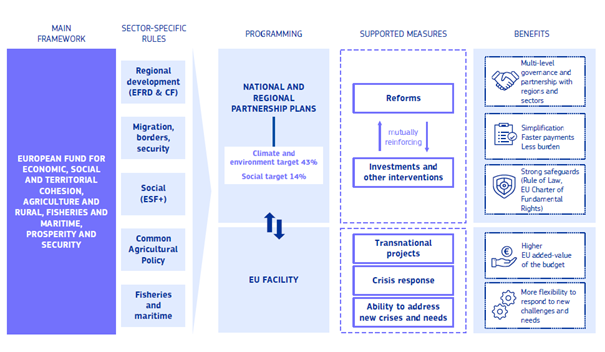
The National and Regional Partnership Plans (NRPPs) covers the majority of the budget and this also the area where the Commission has proposed the most radical structural changes to the MFF by combining the regional and agricultural funds into a single instruments managed by national governments and weakening the role of regions in their distribution. This has already drawn strong criticism from member states and Members of the European Parliament. The European Commission wants the National and Regional Partnership Plans to function similarly to the Recovery and Resilience Facility (RRF) through which Covid-19 recovery funds were distributed to the member states under the principle investments for reform. The NRPPs include funds for regional development and the social fund along other major funds for agriculture and security. One of the objectives of the proposal is ‘promoting culture as a catalyst for European values and supporting a vibrant diverse cultural sector’.
Find more detailed info below on these NRRP components that are especially relevant for the music and cultural sector:
European Social Fund (ESF)
Latest updates from the European Parliament
- The Employment and Social Affairs Committee (EMPL) in the European Parliament published its draft report and amendments (part i and part II) in May 2026. In both the draft report and the amendments there are several proposals for a more explicit inclusion of culture into the ESF with some amendments even calling for a minimum allocation of 5% of ESF resources by each member state to culture. The vote in the committee on the draft report and the amendments is scheduled for November 2026.
- The Culture and Education Committee has adopted its opinion on the European Social Fund (ESF) which will now be taken into consideration by the Employment and Social Affairs Committee (EMPL) when working on their report.
- The European Commission published its proposal on the European Social Fund (ESF) in July 2025. The ESF will support EU policy implementation, and national or regional structural reforms in the areas of employment, education and skills, social inclusion, and care services including long term and healthcare.
European Regional Development Fund (ERDF)
Latest updates from the European Parliament
- The Culture and Education Committee has adopted its opinion on the European Regional Development Fund in June 2026 which the committees responsible will take into consideration in the drafting of their report and amendments.
- The three committees responsible (Budget - BUDG, Regional Development - REGI and Agriculture - AGRI) have published their draft report on the European Regional Development Fund (ERDF). It was last discussed in their joint meeting on 3 June. The next debate including on the amendments to the draft report (not published yet) will take place on 14 July 2026.
- The European Commission published its proposal on the European Regional Development Fund (ERDF) in July 2025. The overall aim of the ERDF is to promote economic, social and territorial cohesion, the sustainable development and competitiveness of the EU, its security and its preparedness.
Global Europe
| Global Europe is the proposal for the EU’s fund for the cooperation with countries and regions that are not members of the EU and has three general objectives: 1. Uphold and promote the EU’s values and interests worldwide, 2. Contribute to the promotion of multilaterialism and a rules-based international order, 3. Promote stronger mutually beneficial partnerships with partner countries, contributing simultaneously to the sustainable development of partner countries and to the strategic interests of the EU. The proposal includes several Annexes, each defining specific objectives for each country or region: Ukraine; Enlargement and Neighbourhood East area; Middle East, North Africa and the Gulf; Sub-Saharan Africa; Americas and the Caribbean; Asia and the Pacific. Culture is included in all of these country/region proposals such as promoting social and cultural inclusion across borders, preserving and promoting cultural and natural heritage, promoting mutual understanding through culture, promoting the role of culture and intercultural dialogue and more. |